
Complete Guide to Professional Coin Grading
Coin grading is the process of scoring a coin’s condition on the Sheldon 1–70 scale used by PCGS and NGC. A coin grade is the letter-and-number shorthand of coin collector terminology — it tells you what a coin is worth before you buy or sell. PCGS vs NGC compares the two grading services, and Elite Coin Group is here to guide you through every grade from Poor (P-1) to Perfect Mint State (MS-70).
By Tim Miner · Elite Coin Group. Reviewed against published PCGS and NGC grading standards. Updated November 2026.
A coin grade is a score from 1 to 70 that describes a coin’s condition on the Sheldon scale. The scale runs from 1 (barely identifiable) to 70 (a perfect coin with no post-production imperfections visible at 5x magnification). Intermediate steps, such as AU-58 for about-uncirculated coins and MS-60 to MS-70 for uncirculated coins, describe how much wear and how many contact marks a coin shows. PCGS and NGC grade coins on this same 1-70 scale and seal graded coins in tamper-evident holders with the grade printed on the label.
The highest coin grade is 70 — a perfect score on the Sheldon 1–70 scale used by PCGS and NGC. Mint-state coins top out at MS-70 (Mint State 70), proofs at PF-70 (Proof 70), and specimen strikes at SP-70. A coin graded 70 shows no post-production imperfections visible at 5× magnification — nothing grades higher than 70. Perfect-70 coins are scarce, which is why they command the strongest premiums.
Two current examples from our certified inventory: the 2025 £10 Battle of Independence PF70 Signed by Michael Gaudioso and the 2026 Coming To Life Silver Buffalo Nickel NGC MS70 Advanced Releases. The artists behind these signed coins have their own profiles: Michael Gaudioso and Martin Jennings.
“Coin ratings” is collector shorthand for a coin grade — the 1-to-70 condition number a third-party grading service assigns, plus the prefix that tells you how the coin was struck or handled. Reading a holder label left to right: the service (PCGS or NGC), the grade (for example PF-70, Proof 70), and any finish or label designation (Ultra Cameo, First Day of Issue, Advanced Releases).
The higher the number, the fewer the imperfections: P-1 is a barely identifiable piece of metal, AU-58 shows a trace of friction on an otherwise unworn coin, and 70 is perfect as struck. The prefixes: MS = Mint State (business strike), PF = Proof, SP = Specimen.
Created by Dr. William H. Sheldon in 1949, this evaluation system revolutionized numismatics by providing a standardized method to evaluate coins objectively. Today, professional grading services like PCGS and NGC use the Sheldon Scale as the foundation for all coin authentication.
Coin collector terminology: grading-scale glossary
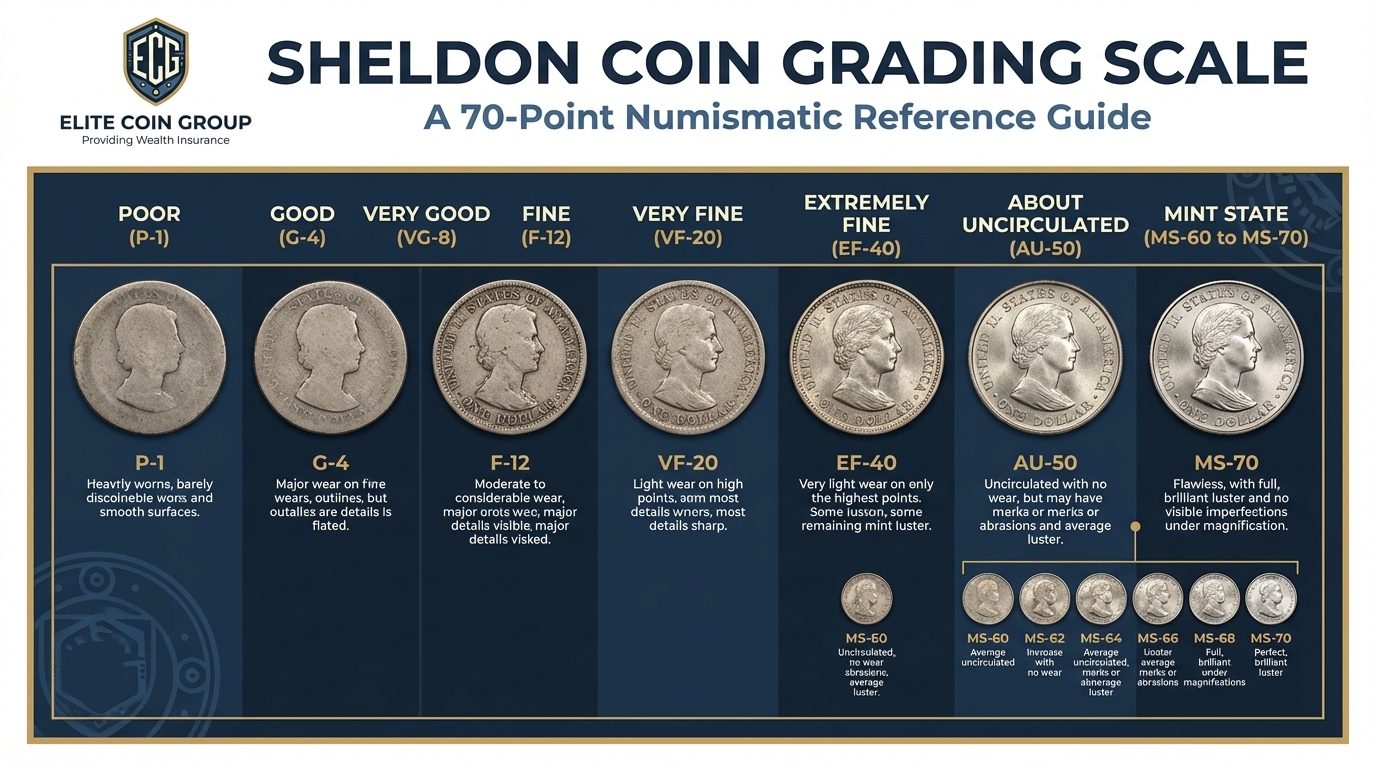
Proper grade assessment directly impacts your investment decisions. Moreover, understanding these factors helps you make informed choices:
Whether you are interested in self-directed precious metals IRAs or building a personal collection, understanding grading is fundamental to making informed decisions.

MS-70 (Perfect Uncirculated)
A flawless coin with perfect luster, strike, and eye appeal. Consequently, no contact marks, hairlines, or imperfections appear even under 5x magnification. MS-70 coins are exceptionally rare and command premium prices.
MS-69 (Superb Gem)
Nearly perfect condition with only one or two minuscule imperfections visible under magnification. Additionally, these coins feature outstanding luster and strike quality.
MS-68 to MS-65 (Gem Uncirculated)
High-quality uncirculated coins with minimal contact marks. Furthermore, excellent luster, strong strike, and attractive eye appeal make these investment-quality coins.
MS-64 to MS-60 (Uncirculated)
Uncirculated coins with noticeable contact marks and possible weak strikes. However, they still retain full mint luster but show more imperfections than higher grades.
About Uncirculated (AU-58 to AU-50)
Light wear on the highest points of the coin design. Specifically, AU-58 shows just a trace of wear with nearly full luster. These coins maintain strong detail and are popular with collectors seeking value.
Extremely Fine (EF-45, EF-40)
Light wear across the entire coin with all major design elements sharp and well-defined. Moreover, approximately 90-95% of original mint luster may remain on EF-45 coins.
Very Fine (VF-35 to VF-20)
Moderate wear on high points with all major design features clearly visible. As a result, coins in VF condition show good detail and are often collectible on a budget.
Fine (F-15, F-12)
Considerable wear with major design elements still visible and identifiable. Nevertheless, lettering and date remain clear, showing history while maintaining collectible value.
Very Good to Poor (VG-10 to P-1)
Well-worn to heavily worn coins with decreasing detail visibility. Importantly, these lower grades can still hold significant value for rare dates and varieties.
When evaluating coins, experts assess five key factors. Understanding these criteria helps you evaluate your own collection more accurately:
The relationship between grade and value is exponential, not linear. For example, consider how dramatically value increases for a Morgan Silver Dollar:
| Grade | Approximate Value |
|---|---|
| VF-20 (Very Fine) | $35 |
| MS-65 (Gem Uncirculated) | $150 |
| MS-67 (Superb Gem) | $3,500+ |
This dramatic value increase at higher grades emphasizes the importance of accurate assessment and professional authentication for valuable coins. Consequently, investing in professional grading often pays for itself many times over.
Graded examples currently listed at Elite Coin Group include the 2023-S $1 Morgan & Peace Dollar NGC Reverse PF70 2-Coin Set, the 2024 Silver Flowing Hair Medal NGC MS70, the 2026 Trump Dollar July 4th Privy PCGS MS65, the 1991 $25 Gold Eagle NGC MS70, and the 2017-W Gold Eagle 4-Coin Set NGC PF70 FDOI.
SP70 is the top grade for a Specimen strike. SP stands for Specimen — a special finish between a regular Mint State strike and a Proof. Per NGC, a Specimen falls short of a true Proof but is superior to a normal circulation issue, and SP70 means no post-production imperfections are visible at 5× magnification.
| Prefix | Strike type | Perfect grade |
|---|---|---|
| MS — Mint State | Business strike — regular dies and planchets, made for circulation | MS-70 |
| SP — Specimen | Special finish between Mint State and Proof (per NGC) | SP-70 |
| PF / PR — Proof | Struck for collectors with polished dies and planchets and mirrored fields — PCGS writes PR, NGC writes PF | PF-70 / PR-70 |
MS70, PF70 and PR70 are all perfect grades on the same 1–70 scale. The difference is the type of coin and which service graded it: MS70 is a flawless Mint State (business-strike) coin, while PF70 (NGC) and PR70 (PCGS) both describe a flawless Proof coin.
| Grade | Strike type | Perfect 70 means | Label used by |
|---|---|---|---|
| MS70 | Mint State — business strike | Flawless uncirculated coin | NGC and PCGS |
| PF70 | Proof — specially struck | Flawless Proof coin | NGC |
| PR70 | Proof — specially struck | Flawless Proof coin (same grade as PF70) | PCGS |
Prefix conventions follow the published scales at PCGS and NGC.
Browse PCGS- and NGC-graded coins in our Certified Gold Coins and Certified Silver Coins collections.
PCGS (Professional Coin Grading Service, founded 1986) and NGC (Numismatic Guaranty Company, founded 1987) are the two dominant third-party coin grading services in the United States. Both authenticate coins, grade them on the 1–70 Sheldon scale, and seal them in tamper-evident holders (“slabs”) printed with a certification number you can check free online — PCGS cert verification and NGC cert verification.
So which is better? Neither, universally. Both stand behind their grades, publish population/census reports, and run set registries; market prices for a given grade can differ by coin and by service, so compare actual sales. Buy the coin — date, grade, eye appeal and price — not just the holder. Elite Coin Group carries both services: our 2026 American Silver Eagle graded MS-70 by PCGS and our 2025 $5 Gold Eagle graded MS-70 by NGC are the same idea executed by different graders.
For a side-by-side breakdown of both services, see PCGS vs NGC grading compared.
| Feature | PCGS | NGC |
|---|---|---|
| Founded | 1986 | 1987 |
| Grading scale | Sheldon 1–70 | Sheldon 1–70 |
| Grade guarantee | PCGS Guarantee | NGC Guarantee |
| First-strike-style designations | FirstStrike® | First Releases / Early Releases |
| Population data | PCGS Population Report | NGC Census |
| Online certification verification | pcgs.com cert lookup | ngccoin.com cert lookup |
Dr. William H. Sheldon proposed the 1–70 scale in 1949, and every major grading service uses it today. Below mint state, grades move in single points; in mint state the market concentrates on MS-60, MS-63, MS-65 and MS-70, with 66–69 common on modern issues.
| Band | Grades | What it means |
|---|---|---|
| Poor to About Good | PO-1 to AG-3 | Heavily worn; date and type barely identifiable |
| Good to Fine | G-4 to F-15 | Well worn; major details visible |
| Very Fine | VF-20 to VF-35 | Light, even wear; fine details sharp |
| Extremely Fine | EF-40 to EF-45 (also written XF) | Wear only on the highest points |
| About Uncirculated | AU-50 to AU-58 | A trace of friction; most original luster |
| Mint State | MS-60 to MS-70 | No wear at all; MS-60 baggy, MS-63 choice, MS-65 gem, MS-70 perfect as struck |
| Proof / Specimen | PF-70, SP-70 | Proof or specimen finishes, judged on the same 1–70 scale |
The letters in front of the number tell you how the coin was made. MS (Mint State) is a regular business strike that never circulated; MS-70 is a perfect coin as it left the mint. PF (or PR) marks a proof — struck at least twice on polished planchets, with mirror fields and, in deep cameo (DCAM/UCAM), frosted devices; see our 2026 Proof Gold Buffalo graded PF-70 by NGC for an example of the PF-70 signature label. SP (specimen) sits between the two: coins with special finishes, such as enhanced-finish issues, are graded SP-70 — like our 2026-W Enhanced Silver Eagle SP-70. There is no grade above 70: on the Sheldon scale, 70 is the ceiling.
The full 1–70 chart in one view: the number sets the condition, the prefix shows how the coin was struck — per the published standards at PCGS and NGC.
| 1–70 band | MS — Mint State | PF / PR — Proof | SP — Specimen |
|---|---|---|---|
| 1–59 (circulated) | Not used — worn coins carry a plain grade: PO-1 to AG-3, G-4 to F-15, VF-20 to VF-35, EF-40 to EF-45, AU-50 to AU-58 | Worn proofs can grade below 60 (“impaired” proofs) | Specimen grades are normally 60 and up |
| 60–70 (uncirculated) | MS-60 to MS-70: business strike, no wear — MS-60 baggy, MS-63 choice, MS-65 gem, MS-70 perfect | PF-60 to PF-70 (PCGS labels proofs PR) — mirror finish; PF/PR-70 perfect | SP-60 to SP-70: special finish above a business strike, short of a true proof; SP-70 perfect |
A details grade (a “genuine” holder) means the coin is authentic but has a post-mint problem — it was cleaned, scratched, corroded, repaired or otherwise damaged. The services will not assign a straight numeric grade to it; the label reads like “Genuine — Cleaned — AU Details.” Because original surfaces are what the market pays for, details coins generally sell at a discount to problem-free coins of the same grade. That does not make details coins bad buys — it makes them priced ones. Read the label, verify the certification number, and compare authenticity checks such as eBay’s Authenticity Guarantee for collectible coins and authenticity vs grade on the 1969-S doubled die.
A “raw” coin is uncertified. Grading costs a submission fee (typically $30–$150+ per coin depending on service and tier) plus turnaround time, but it buys three things: independent confirmation the coin is genuine, a fixed grade on a scale everyone trusts, and liquidity — a graded coin can be priced, listed and sold without the buyer regrading it. The table below uses live prices from our own certified inventory against current metal spot value to show what those premiums look like in practice.
| Coin | Grade / service | ECG price (2026-10-20) | Metal value (spot 2026-10-20) | Premium |
|---|---|---|---|---|
| 2026 American Silver Eagle (FS 250th label) | MS-70 PCGS | $129.00 | $57.96 (1 oz Ag) | +123% |
| 2026-W Liberty Bell Privy Silver Eagle, FDOI | PR-70 PCGS | $529.00 | $57.96 (1 oz Ag) | +813% |
| 2026-W Enhanced Silver Eagle, 250th privy, signed | SP-70 PCGS | $598.00 | $57.96 (1 oz Ag) | +932% |
| 2026 Trump Dollar July 4th Privy, signed | MS-65 PCGS | $498.00 | n/a (metal content not published) | n/a |
| 2025 $5 American Gold Eagle, dual signature | MS-70 NGC | $895.00 | $412.51 (0.100 oz Au) | +117% |
| 2025 $100 Gold Liberty High Relief, signed | PR-70 PCGS | $7,950.00 | n/a (weight not stated on product page) | n/a |
| 2026-W 4-Coin Gold Eagle Set, FDOI, signed | PR-70 DCAM PCGS | $15,999.00 | $7,631.44 (1.85 oz Au) | +110% |
Prices observed at elitecoingroup.com on 2026-10-20. Metal value = weight × spot (gold $4,125.10/oz, silver $57.96/oz, gold-api.com, 2026-10-20 17:27 UTC). Premium = price vs metal value only; it includes the cost of grading, scarcity, signatures and provenance. Premiums move with the metals market. Weights follow U.S. Mint denomination standards for each denomination shown; rows marked n/a could not be confirmed. The pattern is clear: perfect-grade modern coins (MS-70, PF-70, SP-70) carry the largest premiums — you are paying for perfect condition, first-day-of-issue provenance and signature labels.
A 1–70 scale introduced by Dr. William H. Sheldon in 1949 and used today by PCGS, NGC and every major grading service. A grade of 1 is a barely identifiable piece of metal; 58 means a trace of friction on an otherwise unworn coin; and 70 means the coin is perfect as struck, with no post-mint imperfections visible at 5× magnification.
70. Mint-state coins top out at MS-70, proofs at PF-70, and specimens at SP-70. No coin grades higher than 70 on the Sheldon scale.
Both are top-tier, and neither is universally better. Compare the specific coin — date, grade, eye appeal and price — rather than the holder. Both services verify certification numbers free online (PCGS cert verification and NGC cert verification, linked above).
PCGS (Professional Coin Grading Service, founded 1986) and NGC (Numismatic Guaranty Company, founded 1987) are the two dominant coin grading companies, and nearly all certified US coins are graded by one of them. Both grade on the 1–70 Sheldon scale, seal coins in tamper-evident holders with a certification number you can verify free online, and are accepted by major dealers and auction houses. ANACS and ICG are smaller established grading services.
A details grade means the coin is genuine but has a post-mint problem such as cleaning, scratches or corrosion. It should sell well below a problem-free (“straight”) grade of the same number. A details coin is not a bad buy if the discount is real — always read the label.
Usually yes for anything collectible, because the sealed holder adds independent authentication, a fixed grade and liquidity. The raw-vs-graded table on this page shows current premiums from our certified inventory versus metal value.
“Coin ratings” is collector shorthand for a coin grade — the same 1-to-70 Sheldon number a grading service assigns, with a prefix showing how the coin was struck: MS (mint state) for business strikes, PF (proof) for mirror-finish proofs and SP (specimen) for special-finish strikes. An “MS-70 rating” is a coin with no wear at all, perfect as struck; a PF-70 rating is a flawless proof; and an AU-58 rating is a coin with a trace of friction and most of its original luster. Ratings and grades are the same number — only the wording differs.
“MS70 to Good” walks the Sheldon 1–70 scale from perfect as struck to heavily worn. MS-70 is perfect as struck, and MS-60 to MS-69 are uncirculated with no wear at all (MS-60 baggy, MS-63 choice, MS-65 gem). AU-50 to AU-58 show a trace of friction on the highest points; EF-40 to EF-45 (also written XF) take wear only on the highest points, VF-20 to VF-35 light, even wear, and G-4 to F-15 progressively heavier wear down to a barely identifiable PO-1 to AG-3. The band-by-band table is in the Sheldon Scale section above.
SP-70 is the perfect Specimen grade. SP stands for Specimen — a hybrid between Mint State and Proof, per NGC: a strike that falls short of a true Proof but is superior to normal circulation issues. The 70 means no post-production imperfections are visible at 5× magnification — the same flawless standard as MS-70 and PF-70.
Both are flawless 70s — the difference is how the coin was struck. An MS70 is a business strike made for circulation: ordinary dies and planchets, no special finish. An SP70 is a Specimen strike, a special finish per NGC that falls short of a true Proof but is superior to a normal circulation issue. Both show no post-production imperfections at 5× magnification.
MS70 is perfect as struck: no post-production imperfections visible at 5× magnification. MS69 is one point lower, a nearly perfect coin with only a very minor imperfection that keeps it off the top grade. Because true 70s are scarce, the one-point gap can mean a significant price difference. Definitions per PCGS and NGC.
Browse Gold Certified, Silver Certified, Pre-1933 U.S. Gold Coins and Pre-1933 U.S. Silver Coins, or the full shop. For this year’s graded releases, see our guide to America’s 250th anniversary coins.
Elite Coin Group specializes in helping collectors understand numismatic grading, build valuable collections, and make informed buying and selling decisions. Contact us today for free appraisal consultations, professional grading assistance, and expert numismatic advice.
Fact-checked by the Elite Coin Group team against the cited sources. Last reviewed November 3, 2026.